Showing posts with label Lebanon. Show all posts

Monday, February 26, 2007

The coming war

The next war against Israel is being prepared. It will, of course, be entirely the fault of the Israelis if anyone dies. The Times.

Hezbollah, the militant Shia organisation, is building a new line of defences just north of the United Nations-patrolled zone in south Lebanon ahead of a potential resumption of war with Israel.

The military build-up, only six months after the last Lebanon-Israel conflict, is being conducted in valleys and hillsides guarded by uniformed Hezbollah fighters in the rugged mountains north of the Litani river — the limit of the 12,000 strong UN Interim Force In Lebanon (Unifil).
Christian and Druze-owned land is being bought for cash by a Shia businessman. Hezbollah’s opponents believe the goal is to create a Shia-populated belt spanning the northern bank of the Litani, allowing the Lebanese group to operate away from prying eyes.

“The state of Hezbollah is already in existence in south Lebanon,” the Druze leader and arch Hezbollah critic Walid Jumblatt told The Times.
From another article in The Times:
These purchases will create a continuous Shia zone running from the edge of the long-disputed Shebaa Farms area all the way across to the coastline. Lebanon is in effect being physically divided by this initiative. This is terrain in which Hezbollah will soon be able to function much as it wishes. It is beyond the reach of the UN and its soldiers. It is already being described in the region as a “new Maginot Line”.

There is, though, a crucial difference. The original Maginot Line was defensive in its character. This one is not.
In a speech given in South Beirut on February 16, 2007, Hassan Nasrallah said
We are being very clear and we are saying that we have arms. We are not lying and [we are] telling it to the whole world. ...It [Hezbollah] is saying it in public, adding that it is rearming and increasing the scope of its armament in order to get more dangerous arms…

The resistance [i.e., Hezbollah] notes that it is transporting the arms to the front. We stress our commitment to the resistance [interpret as you wish], to the cause of the resistance and to the project of the resistance that defends the homeland...

Hezbollah… is willing to wage jihad and persist with its struggle for justice in all areas…

Tuesday, January 16, 2007

I am not Osama bin Laden

Michael Totten interviews Sayyed Mohammad Ali El Husseini, a Shia alama who lives in the dahiyeh, the Hezbollah stronghold in Beirut. He is, however, firmly opposed to Hezbollah, wants the Iranians out, is grateful to Bush for getting the Syrians out, is a bit cagey about Israel, approves of the American removal of Saddam Hussein and seems favourably disposed towards democracy, or at least, sees dictatorship as violence. In other words, not your raving Muslim cleric that we can't get enough of. I wish we'd heard from blokes like this during the Cartoons ruckus or similar upheavals in the Arab and Muslim Street.

While I was in Germany, I met a student. He told me that I am a Muslim, that I am a terrorist. I told him that he is the German, that he burned people. I said Why are you talking to me? I didn’t burn anybody. I told him also that I didn’t terrorize anybody, and that I was the first person to condemn what Osama bin Laden did to America on 9/11. I told him that we, the Shia people, in Iraq we were the first victims. Saddam killed civilian people, he cut off our heads, he blew up our houses. I told him that Hitler burned the Jews. Nobody in the world has done what he did. Then I told him we are the same. You are German, and you are not Hitler. I am a Muslim, but I am not Osama bin Laden.”
[Italics in original]
Wish I'd been there for that conversation. About the Hezbollah protests in downtown Beirut
“All of those people,” Husseini said, “most of them, who go to the protest downtown have no work to do. They earn 30 dollars per day.”

“Being downtown they get paid 30 dollars a day?” I said.

“Yes,” he said. “If they had work to do, they will not go down there. This is Iranian money, the green money. Nasrallah talked about it. We must exchange it with government money.”

Friday, January 05, 2007

Armed information

I think there is little doubt that in the Muslim world, and to a great degree in the West, the image of the US is tarnished, to put it mildly. At best, it is seen as a heavy-handed keeper of the status quo; at worst, as an oppressive imperial power willing to kill on a 'vast' scale just to ensure oil supplies and a military presence in the region that holds those resources.

Many (me, included) have blamed the media and kept gimlet-eyes on it to bore through the facade of objectivity and to pick out and hold up the weavils that demonstrate the opposite. They are not difficult to find, especially with regard to Israel. But it's not enough.

Not enough, I mean, to explain the losses we have suffered in the information war. So often it has seemed that what has been gained with vast expenditures of energy, time, wealth and blood can be lost in an instant, in the time it takes for some nutter to press a button on his belt. So often it has seemed that every move we make, no matter how successful in terms of military or economic targets reached, is a mere blundering that destroys more than it protects.

One of the reasons for my enthusiasm for that post on Blackfive that I linked to yesterday was that no only does he explain why it seems that way, but he goes on to analyse what we can do about it. Today I clicked on some of the links he supplies, including the one that is the source for a lot of his ideas (among which, the word 'disaggregation').

It turns out that we have an Australian army captain called David Kilcullen to thank for these insights. And two experiences that got him thinking.

The first was a visit in 1993 to a museum dedicated to the defeat of a separatist Muslim insurgency movement called Darul Islam in the sixties. He wanted to understand how the Indonesian government achieved victory (in part, by doing what the coalition is not allowed to do in Iraq). But then, as he was writing, he witnessed the rise of Jemaah Islamiya in the same region as before as well as the success of the separatist Christian movement in East Timor. The Indonesians used the tactics that had brought them success in the first war, but to no avail. Why not? What was different? Kilcullen got to thinking.

I am not going to even try to cover all the ground he does. Just a couple of examples. He concluded, as many have in the last couple of years, that this is more an information war than a military one. He recalls listening to a bin Laden tape and his list of grievances against America: Palestine, Saudi Arabia, Afghanistan, global warming. Global warming? “I thought, Hang on! What kind of jihadist are you?” He gives several examples of where the point of an action (such as 9/11) is not just to kill, but more importantly send a message to the 'constituency' and to the enemy (us). For example,

As soon as the recent fighting in Lebanon between Hezbollah and Israeli troops ended, Hezbollah marked, with its party flags, houses that had been damaged. Kilcullen said, “That’s not a reconstruction operation—it’s an information operation. It’s influence. They’re going out there to send a couple of messages. To the Lebanese people they’re saying, ‘We’re going to take care of you.’ To all the aid agencies it’s like a dog pissing on trees: they’re saying, ‘We own this house—don’t you touch it.’ ” He went on, “When the aid agencies arrive a few days later, they have to negotiate with Hezbollah because there’s a Hezbollah flag on the house. Hezbollah says, ‘Yeah, you can sell a contract to us to fix up that house.’ It’s an information operation. They’re trying to generate influence.”
Another reason that this analysis strikes me as something more than wishful thinking is its hard-headedness. No sentimental delusions.
[W]inning hearts and minds is not a matter of making local people like you—as some American initiates to counterinsurgency whom I met in Iraq seemed to believe—but of getting them to accept that supporting your side is in their interest, which requires an element of coercion. Kilcullen met senior European officers with the NATO force in Afghanistan who seemed to be applying “a development model to counterinsurgency,” hoping that gratitude for good work would bring the Afghans over to their side. He told me, “In a counterinsurgency, the gratitude effect will last until the sun goes down and the insurgents show up and say, ‘You’re on our side, aren’t you? Otherwise, we’re going to kill you.’ If one side is willing to apply lethal force to bring the population to its side and the other side isn’t, ultimately you’re going to find yourself losing.” Kilcullen was describing a willingness to show local people that supporting the enemy risks harm and hardship.
There's an article from the New Yorker about Kilcullen and two pieces by the man himself: Twenty-Eight Articles - Fundamentals of Company-level Counterinsurgency (pdf) and Counterinsurgency Redux (pdf).

Thursday, January 04, 2007

Rich and free

Michael Totten in Beirut chats with some Hezbollah kids in the tent city. And they really sound like kids. Here's one exchange.

“So, what is it you hope to accomplish downtown?” I said.
“We want Seniora to leave,” one of them said.
“We want to fuck Seniora,” said another.
“I know,” I said. “Why do you want to get rid of him, though? What do you want from the government that you can’t get with Seniora?”
“War!” said one of the kids.
“We want war!” said another.
Which is followed soon after by this:
“We don’t hate the American people, only the government.”
“Okay,” I said. “So why then does Hassan Nasrallah repeatedly say Death to America?” I asked these questions in the most friendly and casual tone of voice I could muster.
“He only means death to the American government.”
“Why doesn’t he make that clear then?” I said.
“He does!”
“No, he doesn’t,” I said. “He says Death to America. What would you think of George W. Bush if he gave speeches where he screamed Death to Lebanon? Come on, guys. Be honest with me. I want to know what you really think.”
“I want to go to America,” the leader kid said. “I love America and I want to live in America. America is rich and free. I want to be rich and free, too.”
And read this piece by Jules Crittenden about Iran's good works in another sphere of influence.

Friday, December 22, 2006

They make great Santas

UNIFIL soldiers hand out presents to Labanese students in Naqoura, South LebanonI don't wish to take easy pot-shots, but ... In addition to putting presents into the hands of children, has UNIFIL actually removed any weapons from the hands of Hezbollah fighters? Has the presence of the German or French warships stopped Syria re-arming Hezbollah?

"When a ship carrying weapons for Hezbollah leaves a Syrian port and heads south, its captain feels safe as long as he doesn't stray more than 11 kilometers from the coast," says Gad Shimron, an Israeli security expert who works for the daily Ma'ariv. The Syrian captain can head comfortably for Hezbollah positions in Lebanon, Shimron elaborates, as if he were shipping a cargo of tomatoes or olives, and the German navy isn't allowed to interfere with his journey.
Photo from Speigel Online here, and article from the same source here.

Thursday, December 07, 2006

Diplomatic shorthand

A Russian trouble-maker is murdered by the most exotic means available in the middle of London. Pierre Gemayel is gunned down on a street in Beirut. Take comfort. This is just diplomacy without the duplicity. It is proof evident that some things never change.

Those who complain that there is a lack of communication between the Bush administration and the Assad regime are not paying attention. By local rules, a well-timed murder such as the gunning down of Pierre Gemayel in Beirut last week is more effective in sending a message than a diplomatic demarche.

This translation of Syrian actions quickly made its way through the Middle East: "You want help in Iraq? It will cost you Lebanon. For starters." That is realpolitik and real communication, Assad-style.
If we sold Lebanon for the sake of a Syrian hand in Iraq (as if there weren't enough Syrian hands in Iraq), then the worst that al-Queda could say about us would be richly deserved.

Friday, December 01, 2006

Lebanon Q & A

Jeha adds a little dollop of hope to a smorgasboard of worrying maybes.

Excerpts.

Are we moving towards a civil war in Lebanon?
In Lebanon, anyone who grows to big for is own boots is pulled back in by the other groups, who will find plenty of allies in doing so. Willing or unwillingly, we are all minorities in this country; whoever tries to impose their will on the others faces war. With assassinations in Lebanon, and suicides in Syria, we are indeed in the middle of a “cloak and dagger”, stealthy war.

Why hasn’t the “real” shooting started?
Syria’s greed is keeping things quiet, for now. With the new US Congress, our sister is hoping for a return to the buffet, in a “Grand Bargain”. As long as it is hoping to get Lebanon back, it will not break it directly. It may hope to spark civil strife by assassinations, demonstrations, but it will shy away from any larger scale confrontation.

[T]he Syrians are smart enough not to move to a direct confrontation, and would try to initiate another “battle of the marionettes ”. Indeed, the assassination of Pierre Gemayel may have been an attempt at sparking another civil war... The fires of anger were quickly quenched, but one should not expect Syria and Iran to give up so easily.

Will the United States be “Defeated” by Iran or Syria?
[B]efore you chant the “Vietnam” mantra, recall that there was not much oil in Indochina. The United States may have “lost its way” and Israel may be scared , but it is no South Vietnam . And Iran is no Soviet Union.

I am reassured, however, by Amine Gemayel’s stance; coming from a father who had just lost a son, his call to calm and prayer has gone a long to calm passions, and saved us another war. Whatever their fault, many of March 14th leaders, have apparently learned the lessons of the civil war and the occupation.
Meanwhile the marionettes are busy.

Thursday, November 23, 2006

Truly scary

Gideon Rachman has an off-the-record interview and is surprised. He outlines the interviewee's background and his own expectations of someone

with longstanding and continuing involvement in the Middle East peace process and personal knowledge of all the major protagonists. So I expected him to say something like this: “The situation is worrying, but there are areas we can make progress in. In particular it is vital to make a new effort on the Israeli-Palestinian problem and to engage Iran and Syria.”
That was from a post on the 9th of November. He mentions the same point in a post today because a commenter had complained about the 'neo-con' nature of the interviewee's views. Rachman reiterates that
the whole point of that reported conversation was precisely that it did not come from the usual neo-con suspects, but from someone with impeccable peacenik credentials. Over the past months I’ve heard similar views not just from the Americans and the Israelis, but from the French and from non-aligned diplomats involved in peace efforts.
What are those views? Well, very similar to those of Walid Phares in the World Defense Review that I posted yesterday. And that, too, is the point.

The interviewee sees the major destabilising force in the region
as an expansionist and over-confident Iran, that is bidding for regional dominance. In his opinion the war in Lebanon over the summer was the “first Israel-Iran war in all but name.” He believes that there will be further Iranian-Israeli wars – perhaps next year.
He believes that
Hizbollah unleashed the fighting, more or less on the direct orders of Tehran. Under pressure because of their nuclear plans, “the Iranians wanted to show that they could destabilise the region just like that”. The Iranians are also using their nuclear programme to further their regional ambitions. A regional nuclear arms race is already beginning.
He has met Ahmadinejad
and describes him as “truly scary”. He adds that he is used to dealing with populist Arab leaders, “but when you talk to them in private, they are usually quite reasonable and rational. Ahmadi-Nejad is not like that.” His impression is that Ahmadi-Nejad is now calling the shots in Iran, and has intimidated the moderates into silence: “They are all scared of him.”
The Saudis, the Jordanians and the Egyptians have told him that they expect all this to end in war. Not only that
They are also much more concerned about Iran than Israel, because “they know that Israel is not really an expansionist power”. Indeed the moderate Arab states would like to form a de facto alliance with Israel to contain Iran – but opinion on the “Arab street” prevents them from doing it.
And finally,
The next round of the struggle will kick off internally in Lebanon.

Wednesday, November 22, 2006

The smoking phone?

Is this article from Ya Libnan just the usual Middle Eastern rumour-mongering?

Kuwaiti Newspaper Alseyassah has reported that a SANA (Syrian Arab News Agency) editor has contacted a Lebanese pro-Syrian newspaper 55 minutes prior to the assassination of Lebanon’s minister Pierre Gemayel inquiring about details of his murder.

The call took place at 3:05 pm Beirut local time. Alseyassah did not name the Lebanese newspaper to protect its identity.

The Alseyassah added that the Lebanese newspaper was extremely surprised about SANA’s call which prompted the SANA reporter to call 10 minutes later and apologize for the original call.

Syria/Iran on the offensive in Lebanon

What's going on in Lebanon? Walid Phares in the World Defense Review seems to have said it a week ago.

1. ...the aim of Hezbollah's summer war with Israel, was to provoke a "strike-back" at the Lebanese Government and reshape the balance of power in Lebanon to the advantage of the Teheran-Damascus axis. Nasrallah and his allies across the sectarian divide aimed at shifting the issue of disarming Hezbollah and militias (according to UNSCR 1559) to crumbling the government, which is supposed to implement this disarming process.

2. By mid-October, Hezbollah and its pro-Syrian allies had begun a political counter offensive aiming at "enlarging" the Seniora cabinet, as a way to paralyzing it further from the inside. The political discussions took longer than anticipated by Hezbollah. Hence, a decision was made in Tehran (and subsequently in Damascus ) to move forward.

3. The perceived results of the midterm elections in the U.S. were read as positive by Tehran and its allies, in the sense that it froze vigorous reactions by the U.S. against any Iranian-Syrian move in Lebanon via Hezbollah. The feelings in Tehran and Damascus, have been that if in the next weeks and months a "thrust" takes place in Lebanon to the advantage of the pro-Syrian camp, Washington will be in no position to react or counter. Ahmedinijad and Assad believe (or have been advised to believe) that "lobbies" are moving in Washington and Brussels to restrain any strong deterrence by the U.S. against the "axis." The theory is that the Bush Administration is too busy "negotiating" with the new leadership in Congress to "dare" a mass move in the Middle East. The analysis also predicts that strong lobbies within the Democratic Party are now positioned to block any serious response to a change in geopolitics in Lebanon. It is believed that the window of opportunity won't be too long before the Administration and the upcoming Congress "understands" the Tehran-Damascus maneuver and create a unified response. Thus, the expectation is that Hezbollah and its allies were told to achieve their goals before the end of the year, and before the new Congress begin business on the Hill.

4. Hezbollah has mobilized its forces from all over the country to position them in the capital and eventually use them in moves in Beirut, the central and southern part of Mount Lebanon, where most government institutions are located. Nasrallah can also bring into "battle" the supporters of General Michel Aoun, the Syrian National-Socialists, the Baathists, and the pro-Syrian Sunni militias, the Islamic Fundamentalists paid by Syria, the Palestinian radicals and the security agencies still under the influence of Syria. This "huge" army can – technically – defeat the thin internal security forces of the government. The Lebanese Army is an unknown factor, with Hezbollah supporters in control of the military regions in the south, the Bekaa, southern suburbs and other positions. In short, the "axis army" is ready to engage in battle in Lebanon. The issue is when, how, and with what outcome.

5. The projected scenario is as follows: Hezbollah and Amal movement ministers will resign from the Government calling for the resignation of the Government. The next move is to have Hezbollah, Amal, and their allies in the Parliament also resign, thus creating "conditions" for what they will coin as new elections and a collapse of the cabinet. Most of these moves have already been accomplished or are on the eve of being implemented. The pro-Syrian President Emile Lahoud will declare the Government and the Parliament as "illegitimate," and call for early legislative elections. The latter, if they take place will be under the smashing influence of Hezbollah's weapons (a show of force was performed in the summer) and of the cohorts of militias and security agencies. Result: a pro-Syrian-Iranian majority in parliament, followed by the formation of an "axis" government in Lebanon. The rest is easy to predict: A terrorism victory.
Sounds bang on to me. No mention of assassinations, though.

(via Dinocrat)

Friday, November 17, 2006

Not fauxtography, but captious captions

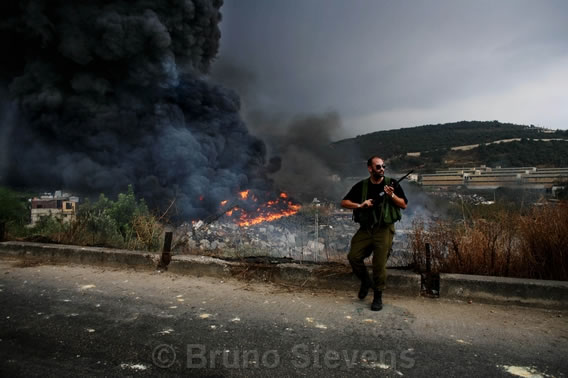
This is an image published by Time with the following caption

The wreckage of a downed Israeli jet that was targeting Hizballah trucks billows smoke behind a Hizballah gunman in Kfar Chima, near Beirut. Jet fuel set the surrounding area ablaze.
The photographer, Bruno Stevens, had sent this
Kfar Chima, near Beirut, July 17, 2006 An Israeli Air Force F16 has alledgedly been shot down while bombing a group of Hezbollah owned trucks, at least one of these trucks contained a medium range ground to ground missile launcher.
You'll notice the shift from "alleged" to "downed Israeli jet" and that the reference to the missile launcher has disappeared in the published version. The Time caption just leaves it as "Hizballah trucks", which raises the question of how the Israelis would know that they were Hizballah, which in turn would lead you to wonder if they just targeted any trucks.

Bruno Stevens went back 3 more times and according to the evidence he gathered came to the following conclusion and so modified his original caption:
Kfar Chima, near Beirut, July 17, 2006 The Israeli Air Force bombed a group of Hezbollah chartered trucks parked on the back of large Lebanese Army barracks , at least one of these trucks contained a medium range ground to ground missile launcher, at least one missile was hit, misfiring high into the sky before falling down and starting a huge fire in the barracks’ parking lot.
Go here to Bruno Stevens' post about the matter and more photographs including ones of the barracks and of a truck with a missile launcher. A heated exchange follows in the comments.

(via Ninme and LGF)