Tuesday, September 19, 2006

Maddy points the finger - away from the culprit

Madeleine Bunting on Pope Benedict. Precisely. On the Pope. And not a single mention of the argument he presented, nor the reaction of Muslims throughout the world or the relevance of that reaction to the argument. She runs through a list of episodes that are supposed to demonstrate the Pope's 'bad faith' and evil intentions, blames him for the way that other people behave (it's the Pope's fault that a nun was killed in Somalia and that churches were attacked on the West Bank). And she finishes with this gem:

...the Catholic church could be failing - yet again - to deal with the challenge of modernity. In the 19th and 20th centuries, it struggled to adapt to an increasingly educated and questioning faithful; now, in the 21st century, it is in danger of failing the great challenge of how we forge new ways of accommodating difference in a crowded, mobile world. The Catholic church has to make a dramatic break with its triumphalist, bigoted past if it is to contribute in any constructive way to chart this new course.
The Catholic Church is not dealing with the challenge of modernity! But at least its way of not dealing with modernity does not involve regular bouts of adolescent hysterics, threats to all and sundry, bombings, shootings and riots. But for those who do deal with not dealing in this way, Maddy has only this to say: It's someone else's fault. (cf Andrew Robb)

Materazzi's Treasure Chest

Materazzi and Nike make play with an infamous incident.


The slogan is, "Every athlete has a secret weapon".

The Fall of Rome and the End of Civilisation 1

The Fall of Rome and the End of Civilisation by Bryan Ward-Perkins is politically important to us now. It may seem strange that a study of (mostly) Western Europe between 400 and 800 should be 'topical'. The Roman Empire fell and things went dark, and that's it. Roman Empire, then Dark Ages. Right? Isn't that how everone sees it? Well, no, actually. That is not the view in Academe.

One of the most popular and flourishing areas of classical studies in recent decades has been what is termed Late Antiquity, applied to the years between 250 and 800. Historians of Late Antiquity prefer not to speak of 'decline', 'fall' or even 'crisis' with regard to Rome, but rather of 'transition', 'change' and 'transformation' and the rise of Christianity, Islam and Medieval civilisation. It is "a distinctive and quite decisive period of history that stands on its own" rather than "the unravelling of a once glorious and 'higher' state of civilisation". Not only that, but they downplay the idea of invasion and conquest on the part of the barbarian tribes. Instead they talk about the barbarian desire to be included in the Roman Empire and Rome's attempt to accommodate them, or even make use of them for defence of the Empire itself. Thus was Rome not destroyed but transformed into another type of civilisation, not inferior, only different. In the words of two American historians, this transition occurred in a "natural, organic and ierenic manner" and we should not "problematize the barbarian settlements". (Does that last verb sound a warning to you? Is this beginning to sound familiar?)

At the same time, the 'objects' under study have changed. Instead of political, economic and military developments, historians of Late Antiquity are more interested in the life of the mind and the spirit. Ward-Perkins notes that in the series published by the University of California Press, The Transformation of the Classical Heritage, 30 volumes discuss mind and spirit, 5 or 6 are about politics and administration while there are none on the details of material life. A cynic might put down this change of focus to the lack of material worthy of study, that in the absence of the sophisticated Roman Empire capable of producing and recording this type of history, there is little else that can be studied. However, practitioners prefer to speak of their subjects making a 'cultural choice' for other areas of life, such as the spiritual instead of the political, or clothes and jewelery instead of great buildings. It is not that they were incapable; it is just that they chose not to.

So we don't talk of the fall of a civilisation, but of the rise of a different culture. We don't talk of agression, victory or defeat, but of accommodation and transformation. Above all, we don't make value judgements and claim that this or that civilisation was 'better' than another. In fact, we don't talk about civilisation at all with its connotations of superiority and exclusion; we talk about cultures, and we start from the assumption that all cultures are equal, if different, and must be viewed from their own perspective. (I'm sure this is starting to sound very, very familiar.)

Think about the Romans, and you're thinking about now. Neil Faulkner in The Decline and Fall of Roman Britain likens the Roman influence on the island as comparable to the worst effects of imperialism and capitalism. He goes on to say that the period after the Roman evacuation in the early 400s was a "short golden age" of a people finally free of exploitation. In the popular realm, there's Terry Jones telling us that the much-maligned barbarians were so much more than "the Roman killing-machine that marched out to rob and ruin them". Julius Caesar "makes himself 'Protector of the Gauls'. And by the time he's finished protecting them, he's killed or enslaved two million and he owns the whole of Gaul." Of course, both Faulkner and Jones are really talking about something else: "It's the same as Bush and Blair saying that they're going to rescue the Iraqis from that dreadful leader and killing a quarter-million in the process."

For Faulkner, Jones and their ilk, the Romans are the real 'baddies', and the others by consequence are the 'goodies'. However, there's no need to indulge in this kind of childishness to end up in just as absurd a place. If you take the multi-cultural view propogated by scholars of Late Antiquity, and view what happened in the 5th Century as merely an accommodation and transition to one culture to another of equal status, then you are led into a sort of quietism. If nothing was really lost, what is there to regret? If it is just a smooth change of state, why not just go with the flow and adjust your tastes accordingly? If the first is not preferable to its successor, why bother defending it? It just doesn't matter because they're all equal anyway.

It is to oppose this view that Ward-Perkins wrote The Fall of Rome and the End of Civilisation.

Part 2 is here.
Part 3 is here.

Monday, September 18, 2006

It is your problem

I meant to put this up yesterday, but got distracted by the many colourful items that our Muslim friends fill the news with.

Once again, an Australian minister says it clear.

The Howard Government's multicultural spokesman, Andrew Robb, yesterday told an audience of 100 imams who address Australia's mosques that these were tough times requiring great personal resolve. Mr Robb also called on them to shun a victim mentality that branded any criticism as discrimination.

"We live in a world of terrorism where evil acts are being regularly perpetrated in the name of your faith," Mr Robb said at the Sydney conference.

"And because it is your faith that is being invoked as justification for these evil acts, it is your problem.

"You can't wish it away, or ignore it, just because it has been caused by others.

"Instead, speak up and condemn terrorism, defend your role in the way of life that we all share here in Australia."
[My emphasis]

Fatuous comment - BBC highlights it

One minor curiosity about the BBC's online coverage of the Pope Benedict affair.

The BBC makes great efforts to encourage user interaction and feedback, one way being the reader comments. To make it an obvious and easy task, they plonk one reader's comment in the middle of the page under the banner 'Have your say' and provide the link to do so.

Normally, as stories develop, and new articles are posted, the comment displayed changes as well. For a story like this, they would have no end of choice, and it's hardly an onerous job. In fact, I would have thought there would be some nifty little JavaScript program to do it automatically. Or maybe not, because you would want to be a little bit careful, wouldn't you? Just in case there was an important point to make.

Strangely, on all the BBC reports that I have seen about this affair, they have displayed only one comment of the hundreds that they have received. It is the following:

Pope Benedict probably should self-criticise Christianity's violent past before commenting on the other faith
John Lin, Illinois
Examples here, here and here.

There are several things to note about this, though it hardly seems worth the effort.

First, it's the argument we learn first; before even setting foot on the school playground, we've mastered the finger-pointing, "You, too!" Mind you, it's not as if it grows out of its usefulness: it's what passes for political debate between heavyweights on 'Flagship' news programmes, and it's certainly a perrenial favourite in the listeners'/readers' comments.

Nevertheless, it is only an effective counter in the most blantant examples of hypocrisy for the obvious reason that it avoids the point of the argument entirely. It's ad hominem. It adds nothing. Besides, if it were taken seriously, no-one would be able to use the word 'should' to anyone else. 'Don't hit your sister, Junior.' 'Ha! That's rich coming from you, Dad. There are 7 documented cases of you hitting yours between the ages of 4 and 10. And as for your treatment of your girlfriends, ...'

Secondly, John Lin is obviously not well informed. The Vatican has been almost embarassing in its confessional profusions in recent years, in particular with regard to the very point that the Pope was raising here: the relationship between the faith and violence/coercion. Pope John Paul's 'apologies' to the Jews and for the Inquisition are the two most notable instances. More importantly, there is no part of Catholic theology or approved practice that allows for violence for just the reasons that the Pope gives: it would be against the nature of God.

Thirdly (and this is the most interesting), note who the comment is addressed to: the Pope. It turns the reader's attention not to the important point that the Pope was making, nor to those who are demonstrating its importance by their acts and words. It makes the question, "Did he have a right to say that?" more important than the real question(s): "Is he right in 'his' interpretation? What to do?"

So why does the BBC continue to highlight this fatuity?

Sunday, September 17, 2006

More reason

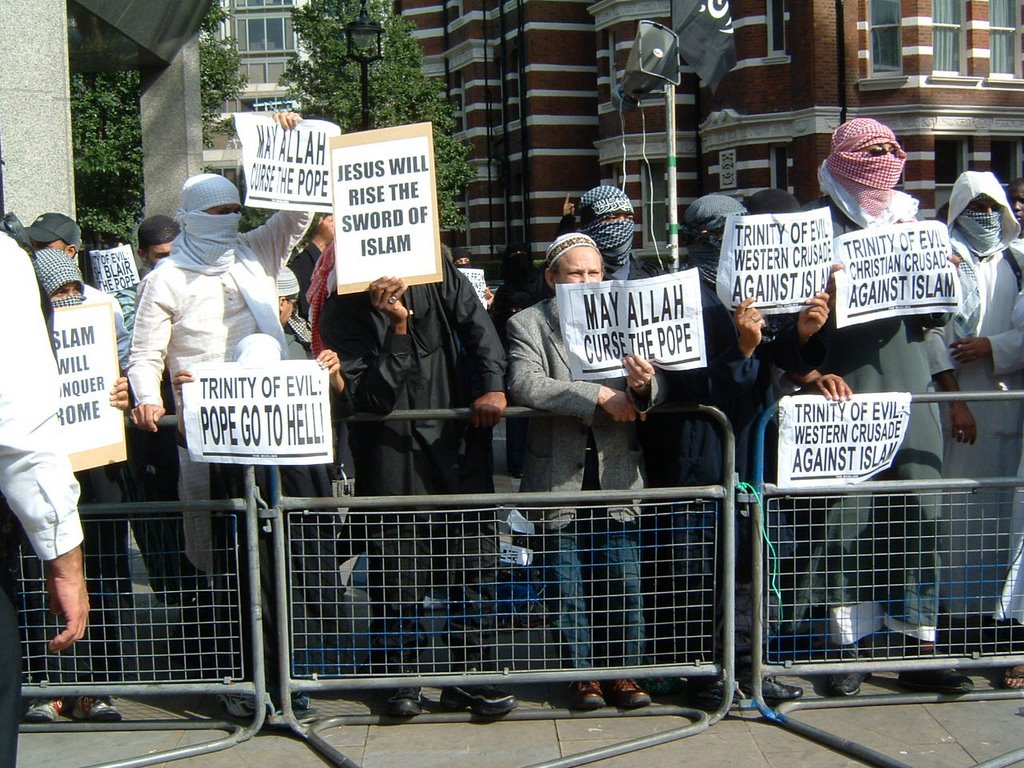
Muslim protest outside Westminster Cathedral
Meanwhile in our own quiet corner of the world...
Joee Blogs took this photo today coming out of Westminster Cathedral after mass.

To save your eyes the effort, a selection of the banners:

Jesus will rise [sic] the sword of Islam
Trinity of evil.
Pope go to hell!
Trinity of evil. Western crusade against Islam
Trinity of evil. Christian crusade against Islam
May Allah curse the Pope
Islam will conquer
Rome
Update
Anjem Choudary, at the Muslim protest on Sunday outside Westminster Cathedral.
The Muslims take their religion very seriously and non-Muslims must appreciate that and they must also understand that there may be serious consequences if you insult Islam and the prophet. Whoever insults the message of Mohammed is going to be subject to capital punishment.

I am here to have a peaceful demonstration. But there may be people in Italy or other parts of the world who would carry that out. I think that warning needs to be understood by all people who want to insult Islam and want to insult the prophet of Islam.

The reaction says it all

What they say:

Afghanistan's Taliban on Saturday demanded Pope Benedict XVI to apologise for remarks linking Islam with violence, adding the comment showed the Christian West was waging war against Muslims.
And
We urge you Muslims wherever you are to hunt down the Pope for his barbaric statements as you have pursued Salman Rushdie, the enemy of Allah who offended our religion. Whoever offends our Prophet Mohammed should be killed on the spot by the nearest Muslim. We call on all Islamic Communities across the world to take revenge on the baseless critic called the pope,” said [Sheikh Abubukar Hassan Malin, a hardline cleric linked to Somalia’s powerful Islamist movement, speaking to worshippers on Friday at a mosque in southern Mogadishu].
And
We want to make it clear that if the pope does not appear on TV and apologize for his comments, we will blow up all of Gaza’s churches,” said the group [The Sword of Islam, claiming the firebombing of the Greek Orthodox church, one of five attacked in Gaza City and the West Bank].
And
A poster has been placed in many Baghdad mosques for the previously unknown group, Kataab Ashbal Al Islam Al Salafi (Islamic Salafist Boy Scout Battalions). This group threatens to kill all Christians in Iraq if the Pope does not apologize in three days in front of the whole world to Mohammed.
(via Tim Blair) In addition,
Op-Eds published in the Arab newspapers slammed the pope even after the Vatican’s apology. The most extreme opinion was voiced by Hani Pahas in the London-based Arabic-language daily newspaper Al-Hayat, who wrote “the pope’s comments may lead to war; we fear that the pope’s statements may lead to a war that we, Muslims and Christians alike, are trying to prevent through dialogue between East and West. Hussein Shabakshy wrote in an article published by the London-based Arabic-language newspaper al-Sharq al-Awsat “It is clear that such remarks only contribute to the fueling of the fire raging between Islam and the West. There is no difference between Osama bin Laden and Ayman al-Zawahiri speaking from their caves in Tora Bora and the stage of an important Christian saint. Both parties contribute to the world verbal weapons for mass destruction. These are ignorant comments previously made by Adolf Hitler, who spoke of a supreme white race against all the other races, especially the African race."

The spiritual leader of Lebanon's Sunnis, the Grand Mufti Sheik Mohammed Rashid Kabbani, said the pope's remarks emanated either from "Ignorance and lack of knowledge or were deliberately intended to distort Islam.""Reason is the substance of Islam and its teachings ... Islam prohibited violence in human life. Anyone who wants the truth (about Islam) must take it from Islam's holy book, the Koran, rather than from a dialogue or excerpts," he said.
(via Jihadwatch)

What they do:
Palestinians wielding guns and firebombs attacked five churches in the West Bank and Gaza on Saturday, following remarks by Pope Benedict that angered many Muslims. No injuries were reported in the attacks, which left church doors charred and walls pockmarked with bullet holes and scorched by firebombs. Churches of various denominations were targeted.
(via Ninme) Furthermore,
According to the website Islam Memo, one Christian was killed in Baghdad after the Pope's speech two days ago. The speech created a wave of anger throughout the Islamic world, including Iraq.
Our reactions:
(A New York Times editorial) [t]he world listens carefully to the words of any pope. And it is tragic and dangerous when one sows pain, either deliberately or carelessly. He needs to offer a deep and persuasive apology, demonstrating that words can also heal.
This is obscene. Apart from its factual inaccuracy -- there is no evidence that any of the enraged Muslims "listened carefully" to the words of the pope -- this is like blaming a beaten wife for provoking the bastard who throttles her. It is the leaders of prayers in the mosques of the Muslim world who call on their faithful to riot in the streets. It is they who sow pain and incite violence, and anybody unburdened by a loathing of Western civilization knows it. Pope Benedict has nothing to apologize for. The leading clerics of the Muslim world have a great deal to apologize for.
David Warren sums up:
The manufacture of grievances, to justify strident demands for their redress, is the tyrant's stock-in-trade. It is what took Adolf Hitler to power over the Germans, and it is what today's Islamic fanatics depend upon to control the Muslims, and push them towards an apocalyptic jihad against the West. Moreover, the basic tactic of bullying is to demand apologies for exaggerated or imaginary offences. It is to make the decent kneel before the indecent.
(via Dinocrat)

Saturday, September 16, 2006

The Pope apologises, but ...

The Pope has apologised for the effect that his words have had; he has not retracted them, nor has he given any further opinion on the contentious quote from the Byzantine Emperor, Manuel II Paleologus. His fundamental point (in relation to Islam) remains valid; his basic question remains unanswered.

The decisive statement in this argument against violent conversion is this: not to act in accordance with reason is contrary to God's nature...
Benedict's speech is about the place of reason. With regard to the secular West, he is saying that we have narrowed the field of reason, constrained it within the bounds of science and therefore excluded not only God, but also Philosphy and Ethics. With regard to Islam, he is saying that, for the Jihadist, reason has been disavowed and that this cannot be pleasing to God. However, there is a further, more general point, one that seems to go to the heart of Islamic doctrine.
But for Muslim teaching, God is absolutely transcendent. His will is not bound up with any of our categories, even that of rationality.
Here is the question. If this interpretation of the Islamic view of God is correct, how can there be discussion either between the faiths, or between Islam and modernity? The question is unanswered; or rather, the answers so far received would seem to indicate, as things stand, there is little (I'm an optimist) possibility of discussion between any of those parties.

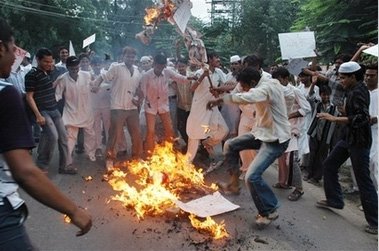
Protesting Muslims burn the Pope's effigy in India

Friday, September 15, 2006

Orianna Fallaci dies

Orianna Fallaci
When in 1943, the Allies were bombing Florence, Orianna Fallaci and her family took refuge in a church. She started crying, at which her father slapped her and told her never to show her tears again. She didn't, but learnt how to give vent to her feelings with the pen.

She saw herself as a voice for the silent and oppressed, as did and do many. However, she never allowed a party or political creed to make use of her voice. During the Vietnam war, she labelled the regime in the North as Stalinist; she swanned in to interview Khomeini wearing vibrant make-up and told him what she thought of the chador; she lured Kissinger into embarassment by admitting that he saw himself as a lone cowboy. She had a tempestuous affair with the Greek agitator Alekos Panagoulis, imprisoned and tortured by the Colonels for his part in an assassination attempt on Papadopoulos. And she adored the United States, where she lived most of the year.

In the meantime, she interviewed most of the major political and cultural figures of the 60s and 70s.

The 11th of September roused her into a passion. She believed the West was betraying itself as a culture, mind-fogged by Political Correctness and weakness of spirit into accommodating an alien and dangerous presence: Islam. She wrote a rambling, but vitriolic attack on Islam and the European response to it in Corriere della Sera, articles which she then expanded into a book, The Rage and the Pride. Her greatest scorn was poured on Western politicians and intellectuals whom she blamed for forgetting and devaluing their own culture and thus surrendering to an invasive and aggressive, but culturally inferior, Islam.

She seemed a very lonely figure in her last years, though that may be a mistaken impression. While an Italian judge saw fit to bring her to court for 'defaming Islam', a trial which started in June, but will never be concluded, 75,000 other Italians signed a petition that she be made a Life Senator.

Her anger did her credit. She loved a Europe that is threatened and she did her best to defend it.

A recent interview with Fallaci in The New Yorker.

Intolerent? Moi?


"The Pope has dishonoured our Prophet. He said our Prophet was a terrorist and he had used sword. Those who say such things whether they are in India or abroad should be punished," said Syeda Tasnim Hasan, a protestor in Jammu.

"His statements have hurt our sentiments. If such statements are repeated the followers of Islam across the world would launch an agitation against Christians," said Mohammed Farooq, a protestor in Varanasi.
In Kashmir, dozens of lawyers wearing black court robes marched Friday through the streets of the summer capital Srinagar, shouting, "Those who dare to target Islam and the Holy Prophet (PBUH) will be finished".
"We have heard about your extremism and hate for Arabs and Muslims. Now that you have dropped the mask from your face we see its ugliness and extremist nature," Syria's top Sunni Muslim religious authority, Sheik Ahmad Badereddine Hassoun.
The Pope's comments were a hot topic on a pro-Hamas radio show for children.
"What do you say about the man who said some bad words about Islam and the Prophet Mohammad?" the radio host asked a 8-year-old Hanin.
Hanin answered: "He is ugly and his words are ugly."