Sunday, July 30, 2006

The sympathetic eye

Charles Moore reflects on the words chosen by a Parliamentarian criticising Israel for its actions in Lebanon, which were described as "a war crime grimly reminiscent of the Nazi atrocity on the Jewish quarter in Warsaw". Standard fare when spoken by hysterics on the Left; a little less to be expected from the longest-serving Tory MP, Sir Peter Tapsell. Moore wonders what possesses otherwise reasonable people when they talk about the Middle East, or more precisely, about Israel.

European discourse on the subject seems to have been overwhelmed by something else - a narrative, told most powerfully by the way television pictures are selected, that makes Israel out as a senseless, imperialist, mass-murdering, racist bully.
Quite apart from the good points that he makes, there is one element that I would like to enlarge upon. It has nothing to do with ideology or partisanship; it could almost be termed 'technical', though its implications for the use and maintenance of Western power are immense.

The most powerful medium for delivering news is television, and television news is most powerful when it is able to evoke sympathy/empathy. A report has impact when it engages the viewer's imagination and it generally does so through pity. Pity at the sight of individual suffering, the what-does-it-feel-like of political and catastrophic events. Show an image of a child's body in adult arms, and you're there. That is what you will remember; that is what will colour, and even dominate, your view of the events. It is direct, emotional and indeniable.

It is perfectly natural that television should tend towards this type of coverage simply because it does what almost any television programme, or virtually any form of communication, seeks to do: it has an impact. The approach is not limited to the small action-filled screen. The teaching of history now is based on the necessity of understanding the viewpoint of the powerless, imaginatively reconstituting the silent voices of the 'disappeared', the bit-actors of great events. One of the aims of traditional studies in literature was the development and refinement of the sympathetic imagination with relation to the lives of those we will never know. This essential social and emotional skill is rightly prized. It is also ruthlessly exploited.

A view dominated by sympathy is extremely limited. Precisely because it has such a hold over us, it is a great impediment to understanding. It distorts perspective; it does not allow the individual events to take their place in a longer and broader view. It reverses the visual logic in Egyptian murals by making the foot-soldier thrice the size of all the other figures in the landscape thus rendering the scene incomprehensible. He had to fight, and he died - that's all, apart from the pity, we will get. It also leads to passivity because it is a litany of helplessness and a rollcall of victims. Since we cannot, through this eyeglass, even glimpse the elements that led to the decisions distantly made; since the potentials averted by those decisions are invisible and weightless, how can that suffering appear if not senseless and cruel?

Attitudes feed by the sympathetic eye of the camera are therefore limited and debilitated. They are politically dangerous because they do not inform effective action. Quite the contrary, they engender fear of action because the immediate consequences of that action are too vividly imagined. It is like the fear of learner drivers who at every turn must look through a blood-coloured veil of their own creation at all the distruction they might create. They lack the perspective to accurately calculate probabilities. They drive reacting to phantoms and are therefore bad drivers incapable of using responsibly the power they possess. If they cannot marginalise their imagination and momentarily treat other road-users as objects of velocity and mass constrained by certain rules, they will never drive well.

Those in power cannot, must not think like this. Their sympathies must be more general and more abstract; their calculation colder and more precise. Otherwise they will be paralysed and, insofar as they are powerful, all the more dangerous. (Cont)

Tagged: , ,

Friday, July 28, 2006

Proportionate outrage

Why is it so difficult to understand that stopping the Israelis now will lead only to more deaths in the future? That if Hezbollah is not hurt badly now then all the suffering that has occurred so far will be to no end but that of reinforcing those that started and financed it? I realise that it is often irresistible to strike the tone of humanitarian outrage, but here it is so out of place.

Excellent Deaths

One evening in the middle of July, 1992, we were going out to a sagra. These are summer 'festivals', really just country dances held over two or three nights in most villages and towns. We were in the Muggello, north-east of Florence, we being my family and my parents over to visit us from the Old Country. A sagra offers a pleasant evening out - lots of food (though, unfortunately for my wife, it's mostly meat) and dancing, almost exclusively 3-step with a live accordianist and backing. And they're outdoors, so the kids can run.

We found our way to San Piero Sieve without great difficulty, parked and went to join the fun. Only there didn't seem to be much of it. All the elements were present - lots of people, the smell of food and smoke in the air with the waltz-time accordian. But subdued. Everything but the enjoyment. People were speaking quietly; only the youngest children were running. Something had happened somewhere to someone. But what, where and who to matter so much to so many? I asked.

The Sicilian Mafia had rid themselves of an enemy in the crudest and most effective way: a massive car bomb that killed Paolo Borsellino and five of the six bodyguards assigned to him outside the house of his mother. Just two months before, they had killed his friend and colleague, Giovanni Falcone, by the same means. Borsellino, like Falcone, had known he was a dead man walking. For together they had taken a step that most thought would never be taken: they took defendants to court for the crime, only recently put on the statute books, of belonging to the Mafia - 474 defendants charged as well with 120 murders, drug trafficking, and extortion. 360 were convicted.

Both Falcone and Borsellino were very impressive men of a steadfastness that had to endure all the frustrations and dangers of a system corrupt almost to the core. Their deaths made them icons of resistence to the tyranny of lawlessness and swayed public opinion so powerfully that the deservedy-maligned state started at last to make the Mafia lords squeal.

A good article from Slate which also reviews a new documentary, Excellent Cadavers, about Falcone and a book by Peter Robb, Midnight in Sicily, a more wide ranging look at that cursed island and its history. Wikipedia entries about Giovanni Falcone and Paolo Borsellino.

Tagged: , , ,

Thursday, July 27, 2006

Johnno by David Malouf

Johnno is a beautifully written elegy to a lost friend and a vanished city. Dante, the narrator, remembers his boyhood friend, Johnno, and the Brisbane of their post-war youth, which he paints in loving detail. He recaptures the heat, the lush vegetation, the pubs and the public library, the back yards and the brothels of a city that with World War 2 had just come into the big world and was about to lose its particular ragged charm and become a modern city just like any other. Johnno is the book that put Brisbane on the literary map, and in a sense that is just what Malouf intended.

It is very much a bildungsromans, a writer finding his personality as a writer and, characteristically, doing so through guilt. What exactly was his part in Johnno's life and death, he wonders. Johnno, who from the first had been Dante's alternative version, his way out of his good Catholic-boy upbringing, his way out of Australia, in the end cursed him. Johnno's final note, delivered days after his (probable) suicide pleaded with Dante to answer his call as he had never done in the past. "I've spent years writing letters to you and you never answer, even when you write back. I've loved you - and you've never given a fuck for me, except as a character in one of your funny stories."

There is justice in his accusation. Dante is a distant figure, even as narrator. He reconstructs a world in fine detail yet somehow manages not to interact with it. Perhaps his most telling line is "I was simply immobilised from within". He observes, in a manner that is very familiar from Henry James (Ralph Touchett in The Portrait of a Lady is a good example), and though he makes use of the energy released from Johnno's clash with the world, he remains on another trajectory, if that is the right word for so motionless a movement. However, it is perhaps one of the weaknesses of the novel that Johnno's search for the right place, the right state of mind, his resolute spiritual shopping, which must have resonated greatly in the Seventies, now makes him seem a rather tiresome figure, spoilt by too much choice and easy rebellions. As a reader, I shared the narrator's lack of committment to Johnno's quest, and I certainly did not feel guilty about it.

Johnno is also a very writerly project. Malouf is determined to be the makar of Brisbane. Dante says at one point that he was happiest when reading about

when everything that happened was history. I was very strong on history. Not the terrible history of our own misplaced continent,… but the history that was recounted in the books I bought at Old Neds in Melbourne Street… Australia was familiar and boring. Now was just days, and events in The Courier mail – even when those events were the Second World War. History was the Past. I had just missed out on it.
Now that the Brisbane of his childhood has been swept away by development and modernity, Malouf makes that place and time something where history has happened, something remembered strongly which is therefore meaningful. He makes Brisbane a place of the imagination. No small thing.

Johnno is a very good novel, and maybe for Australians and Brisbanites, a necessary one. I'm not entirely sure how appealing it would be for others, though it is not only in Brisbane that the need to escape from the flatness of suburban life is an urgent one.

Tagged: , ,

Wednesday, July 26, 2006

Peacock Butterfly

Peacock Butterfly
This Peacock Butterfly, with many mates, seen today on our buddleia.

Tagged: ,

Voices on the Wind

I see no Lebanese or Arab or Islamic need for all that has occurred, and it will do me no good to hold Israel responsible. God rest Dr. Zreik's soul: We can either earn the right to life and dignity or get trampled upon in the name of the right to life and dignity!

Can I recommend a long read? It's a post by a Lebanese living in Canada on his blog Voices on the Wind. The quote is from his translation of an article by a Lebanese called Dr. Radwan el Sayyid. Interesting in itself, but what is worth the time is the discussion that follows in the comments between the blogger and someone going under the moniker of fubar.

Tagged: , , ,

Monday, July 24, 2006

Civilians

From Ralph Kinney Bennett at TCS Daily.

Those who have visited any Hezbollah installation in Lebanon over the years always remark on the fact that there are families, women and children, in and around the place. "Secret" bases are usually hidden in plain site. Houses or apartment buildings become weapons storage or even operations centers. An innocent shed or garage may contain a Toyota or a missile launcher.
Seldom, if ever, has a guerrilla movement been able to so openly and exquisitely weave itself into the fabric of a society as Hezbollah has done in Lebanon.

If the civilians in and around what are in effect operational bases happen to be of Hezbollah's own brand of Islam they automatically become a part of the "sacrificial," suicidal equation. Often without choice or foreknowledge, they die an "honorable" death in the battle against infidels or apostates.

If the civilians happen to be of some other persuasion, Islamic or otherwise, their deaths are not even worth a shrug. However, these mangled bodies and wailing women with arms outstretched do provide an immense propaganda payoff, especially in the Western "crusader" media -- which still places a quaint value on human life.
(via Dinocrat)

Tagged: ,

Grass-high oak tree

Grass-high oak
Look what we found in the garden today. With five perfect leaves.

It can't stay, however much I would like to be at least partly responsible for something that could be around in 300 years. Down to the woods with it, I'm afraid.

Negotiating stance

Hezbollah's representative in Iran, Hossein Safiadeen, leaves the way open for a peace accord.

We are going to make Israel not safe for Israelis. There will be no place they are safe.

We will expand attacks. The people who came to Israel, (they) moved there to live, not to die. If we continue to attack, they will leave.

This war will be remembered as the beginning of the end for Israel.
The audience included the Tehran-based representative of the Palestinian group Hamas and the ambassadors from Lebanon, Syria and the Palestinian Authority.

Tagged: ,

Sunday, July 23, 2006

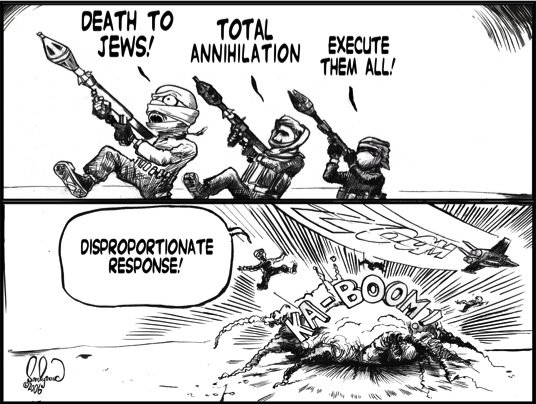
Proportionality


From The Ryskind Sketchbook.

(via Wheat and Weeds)

Tagged: ,